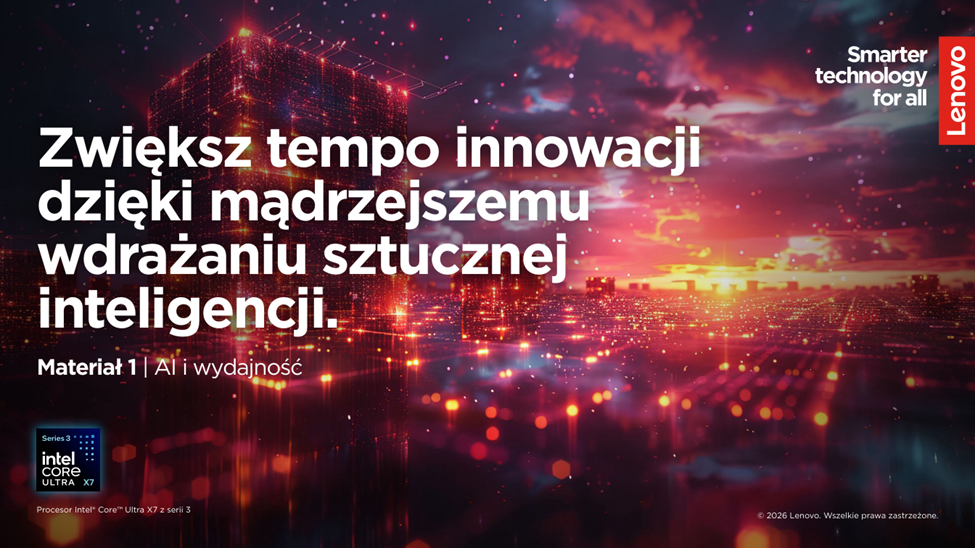

AI Adoption Is Accelerating But Implementation Is the Real Challenge
Artificial intelligence is moving rapidly from experimentation into everyday business operations. The supplied Lenovo material, “AI i wydajność” (AI and productivity), focuses on a practical question: how can organizations increase the pace of innovation by implementing AI more intelligently?
The material highlights a growing gap between the ambition to use AI and the infrastructure, skills, security, and operational readiness required to deploy it at scale. For IT leaders and business decision-makers, the opportunity is significant—but so is the pressure to modernize.
The core message is that successful AI adoption is not only about selecting an AI application. It also depends on modern endpoint infrastructure that can support demanding workloads, protect data, and help employees work productively in hybrid environments.
1. Start by Identifying the Gaps in AI Implementation
AI adoption is accelerating across industries, from executive meeting rooms to frontline employees. Yet the material notes that IT leaders can feel overwhelmed by the challenges of deploying AI at scale, particularly in hybrid work environments.
The right starting point is therefore an honest assessment of the current environment: where are existing devices, workflows, security controls, and employee capabilities slowing down AI adoption?
2. Leadership Pressure Is Rising
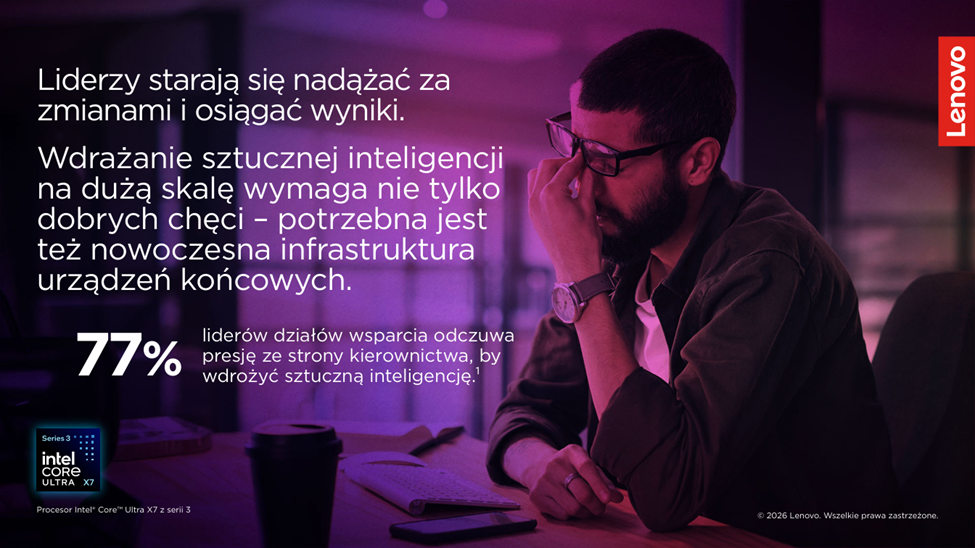
The material highlights that 77% of customer support leaders feel pressure from executives to deploy AI. This shows how AI has moved from a technology experiment to a leadership priority.
However, scaling AI requires more than good intentions. The source emphasizes the importance of modern endpoint infrastructure. If employee devices cannot efficiently support AI-enabled workflows, organizations may struggle to turn AI investment into measurable productivity gains.
3. The Five Major Challenges Holding AI Adoption Back
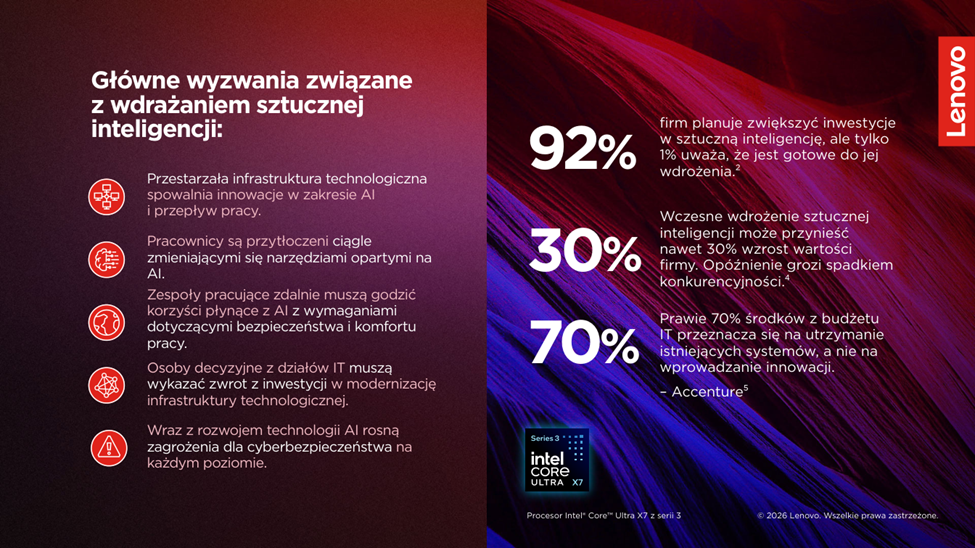
Legacy technology: Outdated infrastructure can slow AI innovation and interrupt efficient workflows.
Employee overload: Employees can become overwhelmed as AI-powered tools and workflows continue to change.
Hybrid-work requirements: Remote and hybrid teams must balance AI benefits with security and employee-comfort requirements.
ROI expectations: IT decision-makers need to demonstrate a return on investment from infrastructure modernization.
Cybersecurity: As AI adoption grows, organizations also face expanding cybersecurity risks across the technology environment.
The source reports that 92% of firms plan to increase AI investment, while only 1% consider themselves ready for AI implementation. It also cites the potential for early AI adoption to deliver up to a 30% increase in company value, while warning that delays can threaten competitiveness.
The material also cites Accenture for the finding that nearly 70% of IT budgets are spent maintaining existing systems rather than introducing innovation.
4. Take a Lower-Risk Route to AI Implementation
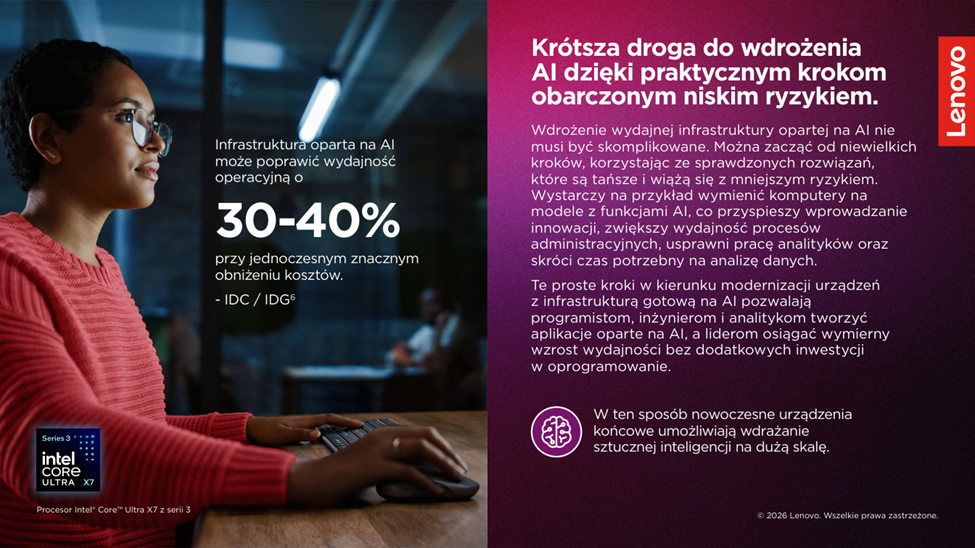
AI infrastructure does not have to be transformed in a single, high-risk project. The material recommends practical, incremental steps based on proven solutions.
One example is upgrading employee PCs to models with AI capabilities. According to the source, this can help accelerate innovation, improve administrative workflows, support analysts, and reduce the time required for data analysis.
Modernizing endpoints can also give developers, engineers, and analysts a foundation for creating AI-powered applications while allowing leaders to pursue measurable productivity improvements without necessarily making additional software investments.
The material cites IDC/IDG for an estimate that AI-optimized infrastructure can improve operational productivity by 30–40% while significantly reducing costs.
5. Why AI-Ready Endpoint Infrastructure Matters
As AI becomes embedded into everyday work, the endpoint becomes an important part of the AI infrastructure. Employees need devices that can support demanding AI-enabled workflows without creating unnecessary friction.
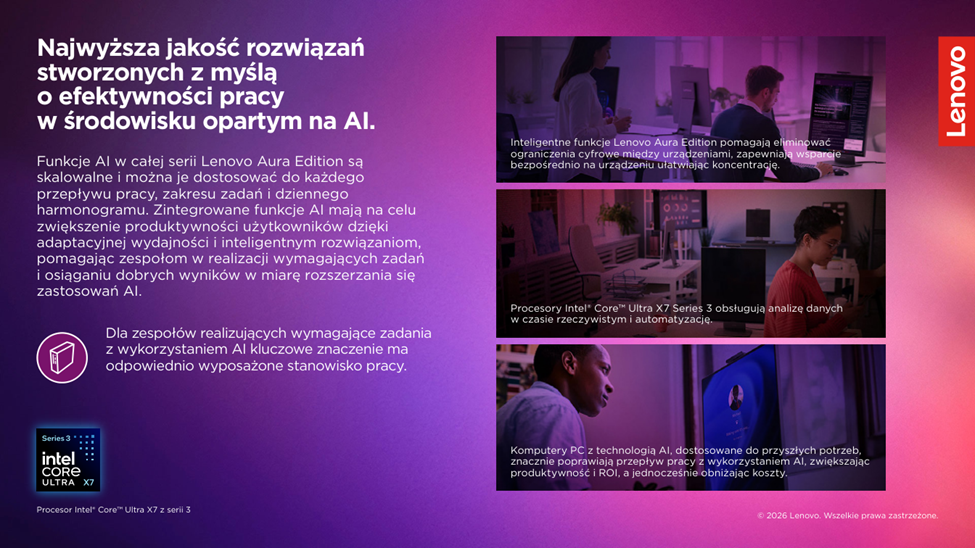
The Lenovo Aura Edition section describes integrated AI capabilities designed to adapt to different workflows, task requirements, and daily schedules. The stated goal is to improve productivity through adaptive performance and intelligent features.
The material also describes on-device support as a way to reduce digital limitations between devices and help users maintain focus. For teams working with demanding AI tasks, having appropriately equipped workstations becomes increasingly important.
6. Real-Time Analysis and Automation at the Edge
The material highlights Intel Core Ultra X7 Series 3 processors as supporting real-time data analysis and automation. It positions AI-enabled PCs as a way to improve AI-based workflows while supporting productivity and return on investment.
This approach is relevant when organizations need responsive AI capabilities close to the employee or device, while also considering privacy and security requirements.
7. Lenovo ThinkCentre X All-in-One: AI Performance Without Added Complexity
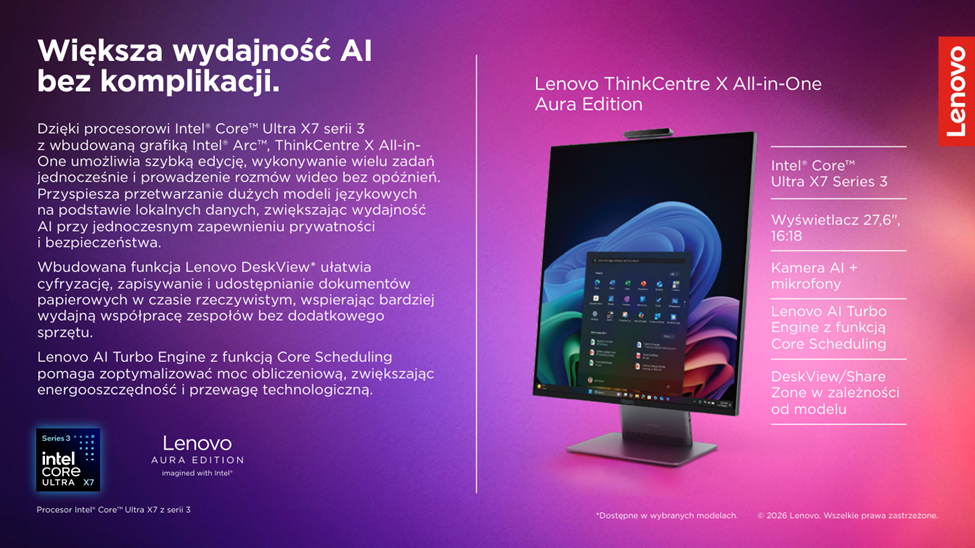
The source presents the Lenovo ThinkCentre X All-in-One Aura Edition as an example of an AI-ready endpoint. It describes the system as using an Intel Core Ultra X7 Series 3 processor with integrated Intel Arc graphics.
According to the material, the device supports fast editing, multitasking, and video conversations, while accelerating large language model processing based on local data. The source connects this approach with improved AI performance alongside privacy and security considerations.
It also highlights Lenovo DeskView for digitizing, saving, and sharing paper documents in real time, as well as Lenovo AI Turbo Engine with Core Scheduling to help optimize computing resources and energy efficiency.
8. The Workplace Experience Still Matters
AI productivity is not only about processing power. The supplied material also emphasizes the importance of a well-equipped workplace.
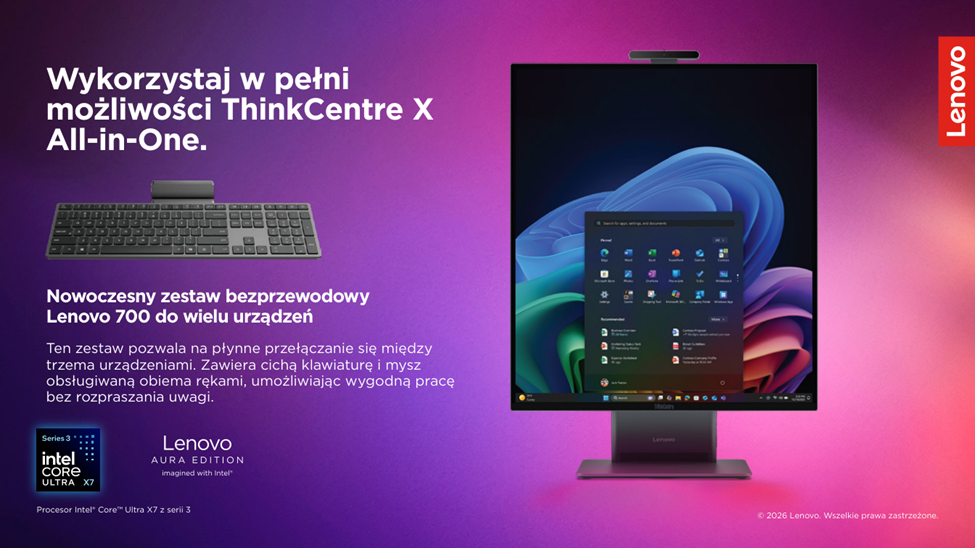
The Lenovo 700 multi-device wireless set is described as allowing users to switch smoothly between three devices. Its quiet keyboard and ambidextrous mouse are presented as tools for comfortable work with fewer distractions.
This reflects a broader point: AI adoption should be designed around the complete employee workflow. Hardware, software, peripherals, security, and user experience all contribute to whether AI becomes a productivity multiplier or another source of complexity.
9. A Practical Framework for Smarter AI Adoption
- Assess current infrastructure and identify the biggest AI-readiness gaps.
- Prioritize high-value workflows where AI can produce measurable productivity improvements.
- Modernize endpoints incrementally instead of treating AI adoption as one large transformation.
- Equip employees with devices capable of supporting AI-enabled workloads.
- Build security and privacy considerations into AI deployment from the beginning.
- Measure productivity, cost, workflow efficiency, and business outcomes to demonstrate ROI.
- Scale successful use cases across teams once the infrastructure and operating model are proven.
Conclusion: Build the Infrastructure That Makes AI Useful
The path to successful AI adoption is not simply about adding more artificial intelligence to the workplace. It is about creating an environment in which people, processes, devices, data, and security can work together.
The Lenovo material makes the case for a practical approach: identify the gaps, modernize infrastructure step by step, equip employees for AI-enabled workflows, and measure the resulting business value. With the right foundation, AI can move from an ambitious technology initiative to a practical productivity engine.
For organizations preparing for the next stage of AI adoption, the key question is no longer only “What can AI do?” It is also “Is our infrastructure ready to let our people use AI effectively, securely, and at scale?”
Complete Source Visuals
All nine pages of the supplied PDF are included below so the final document retains the original visuals, statistics, product imagery, and reference page.