
Key insights from Gartner’s Healthcare Supply Chain Top 25 for 2026
Why Healthcare Supply Chains Matter More Than Ever
Healthcare supply chains are not simply back-office purchasing functions. They help determine whether clinicians have the right products at the right time, whether care can continue through disruption, and whether health systems can manage costs responsibly. Gartner’s 2026 Healthcare Supply Chain Top 25 examines leading U.S. health systems and the practices shaping supply chain transformation.
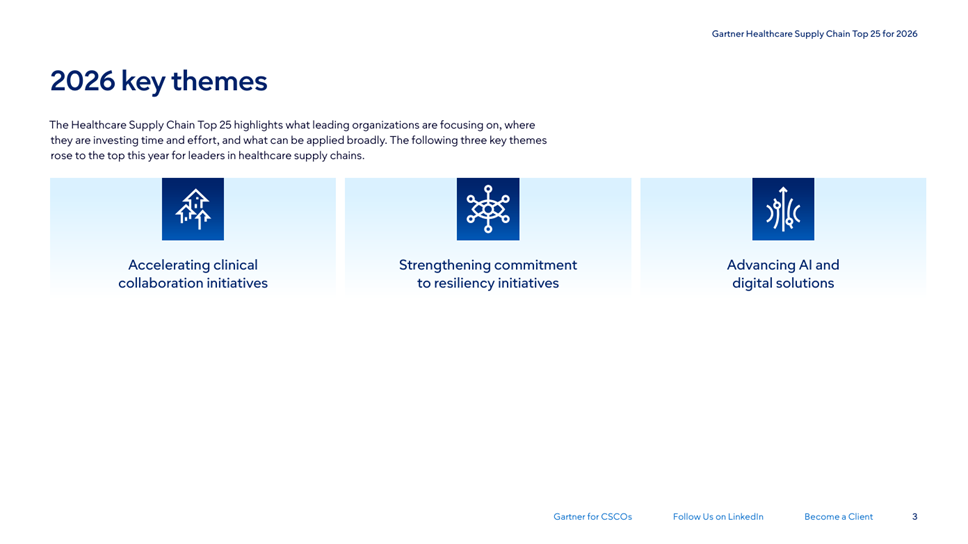
The report frames the purpose clearly: effective supply chains support community health through cost-effective, reliable and socially responsible delivery of products and services that affect patients. Its 2026 edition identifies three themes at the forefront of leading organizations: accelerating clinical collaboration, strengthening resilience, and advancing AI and digital solutions.
How Gartner Built the 2026 Ranking
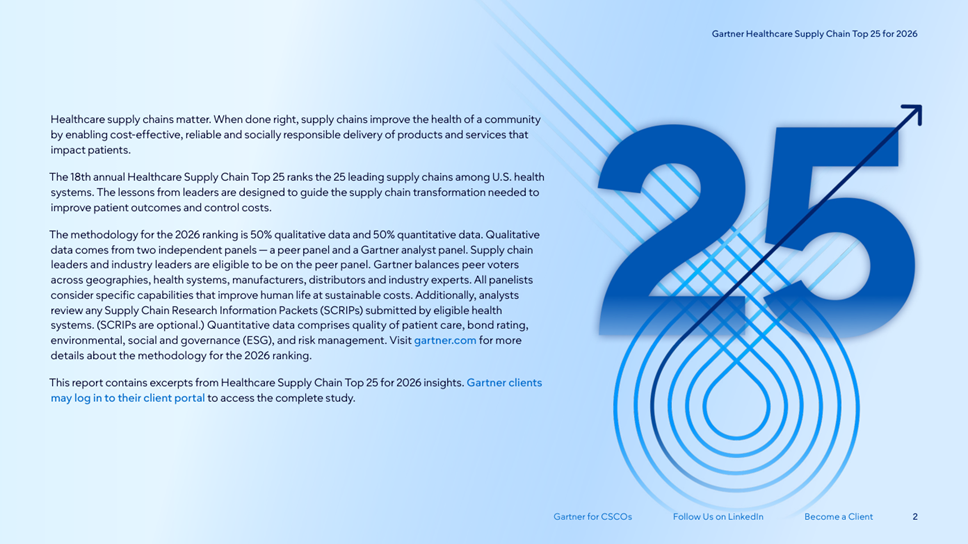
The 18th annual ranking assesses the 25 leading supply chains among U.S. health systems. Gartner says its methodology combines 50% qualitative data and 50% quantitative data. The qualitative portion draws on two independent panels: a peer panel and a Gartner analyst panel. The quantitative portion includes quality of patient care, bond rating, environmental, social and governance (ESG) performance, and risk management. The report notes that eligible health systems may also submit optional Supply Chain Research Information Packets for analyst review.
This blended approach is intended to recognize capabilities that improve human life at sustainable costs, rather than treating supply chain performance as a purchasing-cost exercise alone.
Three Priorities Defining Leading Healthcare Supply Chains
1. Bring clinicians into supply chain decisions
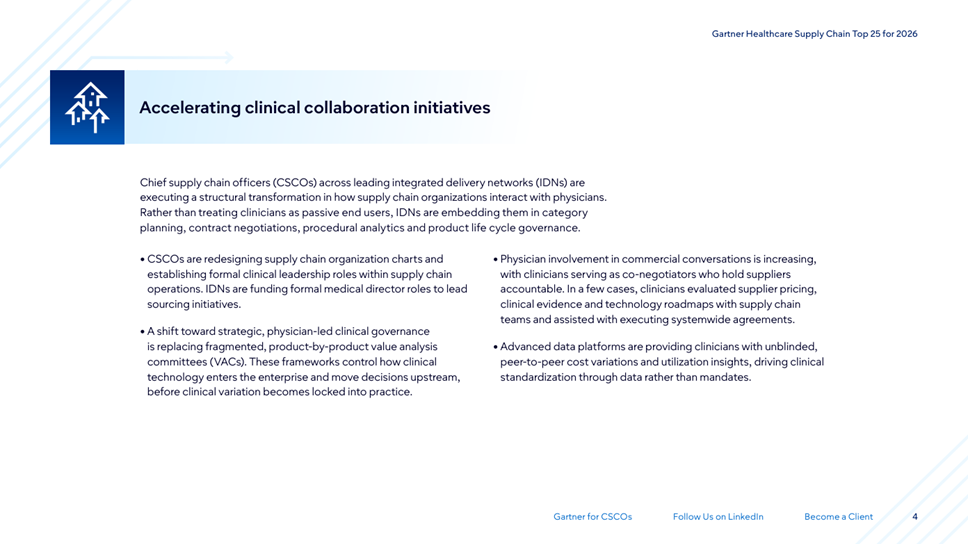
Leading integrated delivery networks are changing the relationship between supply chain teams and physicians. Instead of treating clinicians as end users who receive purchasing decisions, organizations are involving them earlier in category planning, contract negotiations, procedural analytics and product life cycle governance.
The report describes formal clinical leadership roles, medical directors supporting sourcing initiatives, and physician-led governance structures replacing fragmented product-by-product value analysis committees. Clinicians are increasingly participating in supplier conversations and evaluating pricing, clinical evidence and technology roadmaps alongside supply chain teams.
Data is an important enabler. Advanced platforms can show clinicians peer-to-peer cost and utilization variation, helping teams pursue clinical standardization through evidence and insight rather than mandates.
2. Treat resilience as a strategic operating capability
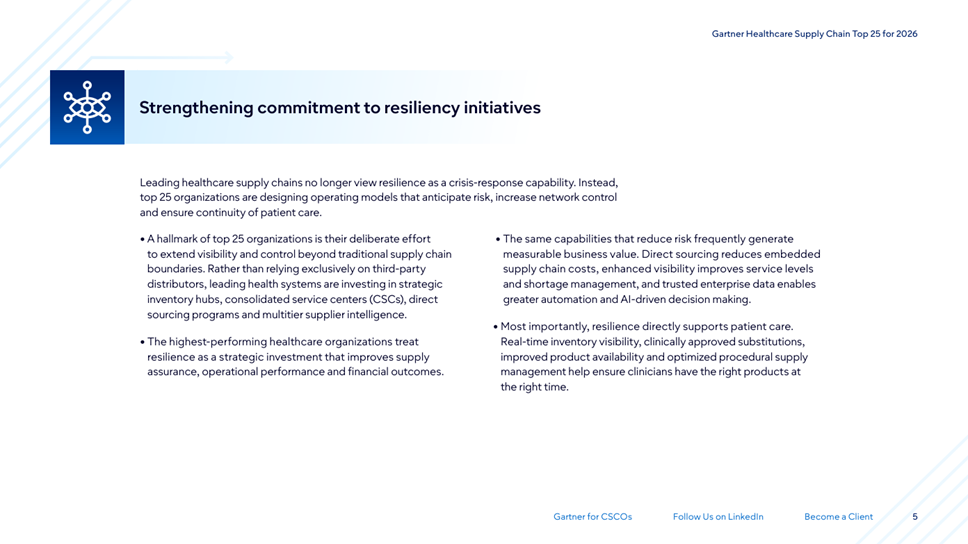
For leading health systems, resilience is no longer limited to responding after a crisis. It is being built into operating models through greater visibility, network control and continuity planning.
Gartner highlights investments in strategic inventory hubs, consolidated service centers, direct sourcing programs and multitier supplier intelligence. These capabilities can reduce reliance on a single distribution route and improve awareness of risks deeper in the supplier network.
The report also connects resilience with business value. Direct sourcing can reduce embedded supply chain costs; better visibility can improve service levels and shortage management; and trusted enterprise data can enable automation and AI-supported decisions. Most importantly, real-time inventory visibility, clinically approved substitutions and optimized procedural supply management help clinicians access needed products.
3. Advance AI and digital solutions
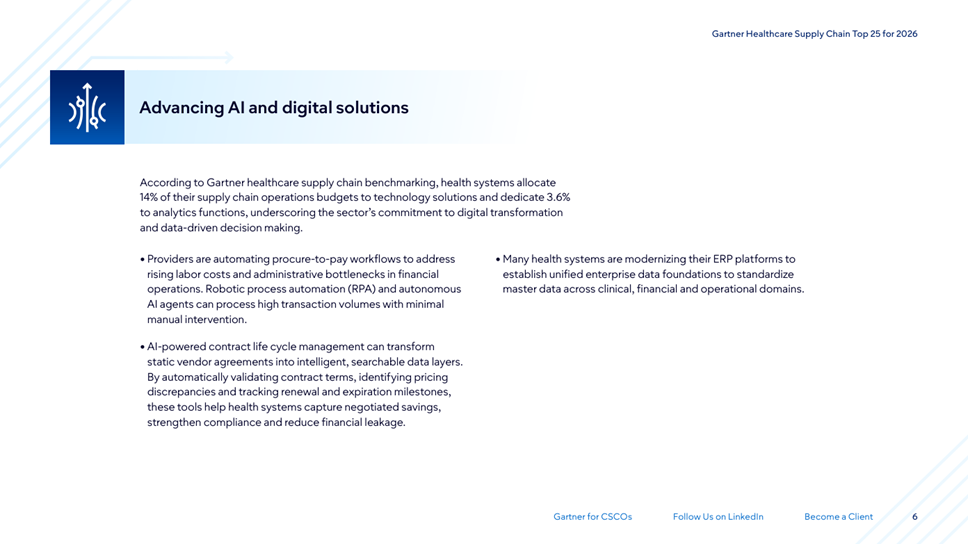
Gartner’s benchmarking indicates that health systems allocate 14% of supply chain operations budgets to technology solutions and 3.6% to analytics functions. The report describes this investment as evidence of the sector’s commitment to digital transformation and data-driven decisions.
Examples include automating procure-to-pay processes with robotic process automation and autonomous AI agents, and using AI-powered contract life cycle management to validate terms, identify pricing discrepancies and track renewals and expirations. These capabilities can help capture negotiated savings, strengthen compliance and reduce financial leakage.
Many health systems are also modernizing enterprise resource planning platforms to create unified data foundations and standardize master data across clinical, financial and operational domains.
What the Top-Ranked Health Systems Are Doing
The report’s profiles of the top 10 organizations show how these themes translate into operational programs. The examples below reflect the report’s descriptions and reported outcomes.
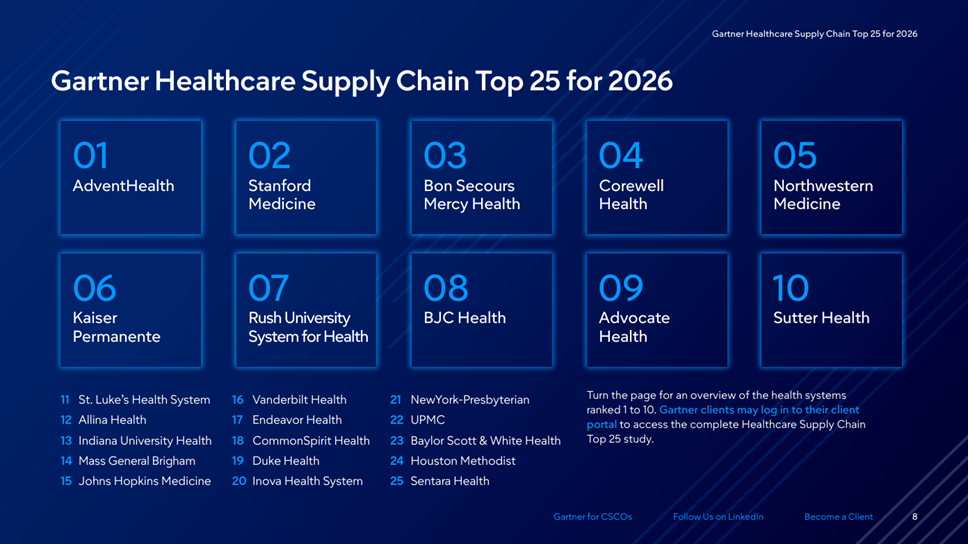
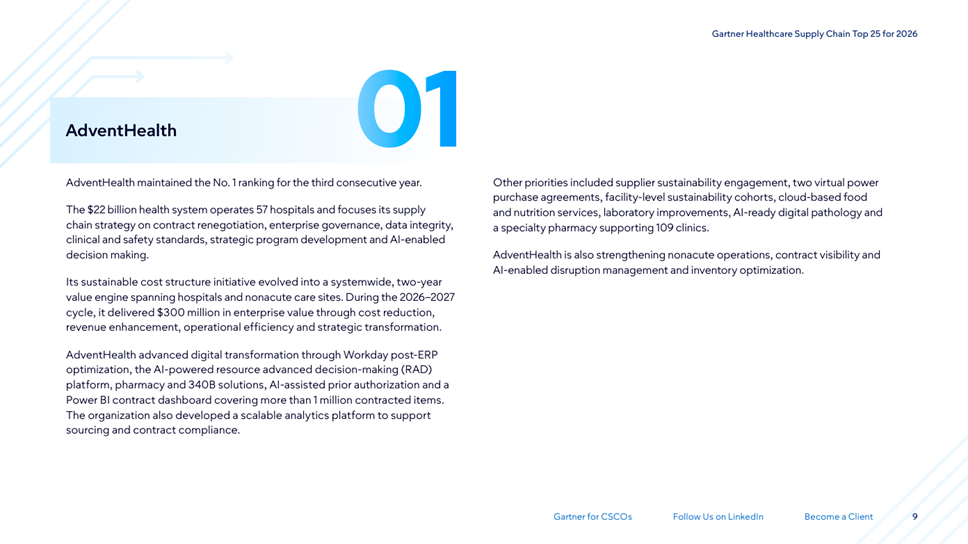
No. 1 — AdventHealth
AdventHealth maintained the top position for the third consecutive year. The report describes a systemwide, two-year value engine that delivered $300 million in enterprise value during the 2026–2027 cycle through cost reduction, revenue enhancement, operational efficiency and strategic transformation. Its digital initiatives include Workday post-ERP optimization, the AI-powered resource advanced decision-making platform, AI-assisted prior authorization and a Power BI contract dashboard covering more than one million contracted items.
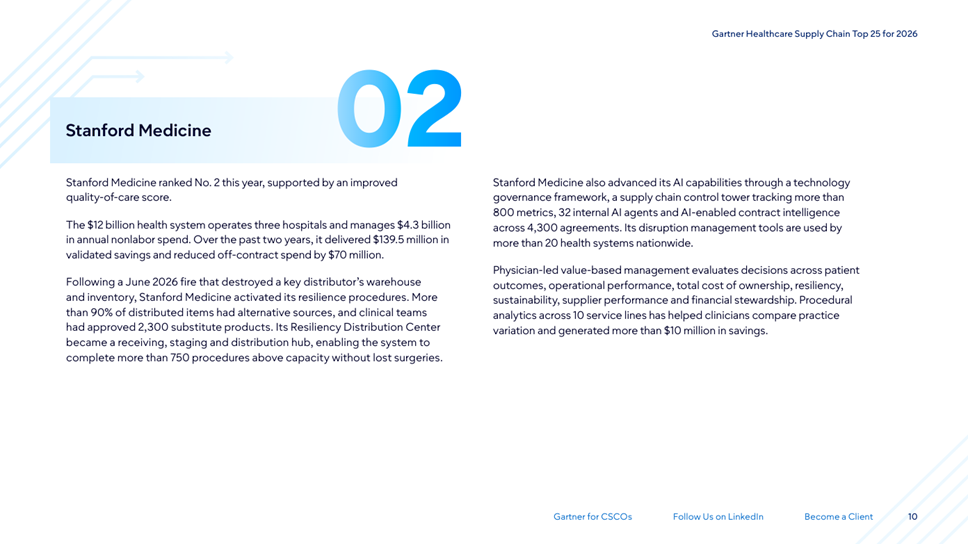
No. 2 — Stanford Medicine
Stanford Medicine ranked second. Following a June 2026 fire that destroyed a key distributor’s warehouse and inventory, the organization activated resilience procedures. More than 90% of distributed items had alternative sources, and clinical teams had approved 2,300 substitute products. Its Resiliency Distribution Center supported receiving, staging and distribution, helping the system complete more than 750 procedures above capacity without lost surgeries. The report also highlights a control tower tracking more than 800 metrics, 32 internal AI agents and AI-enabled contract intelligence across 4,300 agreements.
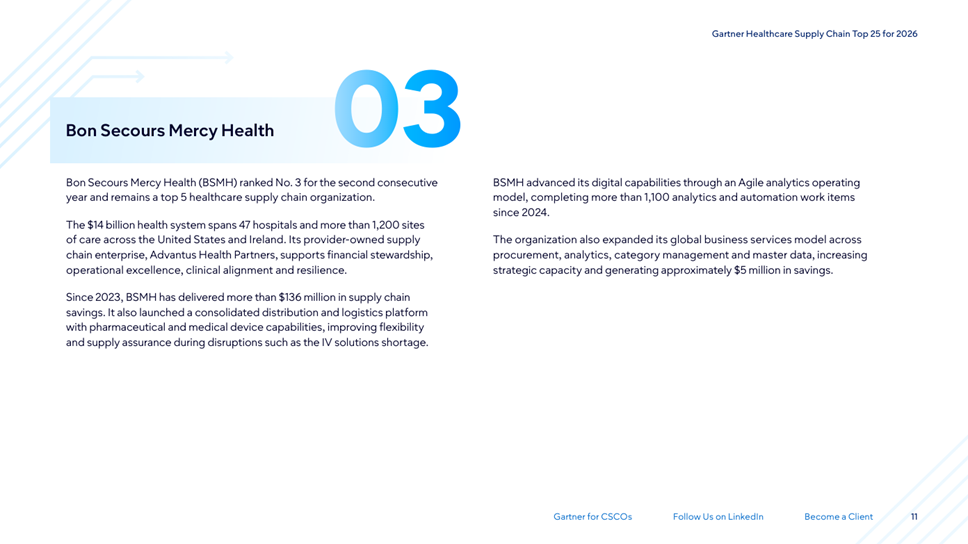
No. 3 — Bon Secours Mercy Health
Bon Secours Mercy Health retained the No. 3 position. Since 2023, it has delivered more than $136 million in supply chain savings. Its consolidated distribution and logistics platform includes pharmaceutical and medical device capabilities, supporting flexibility and supply assurance. The organization also completed more than 1,100 analytics and automation work items since 2024.
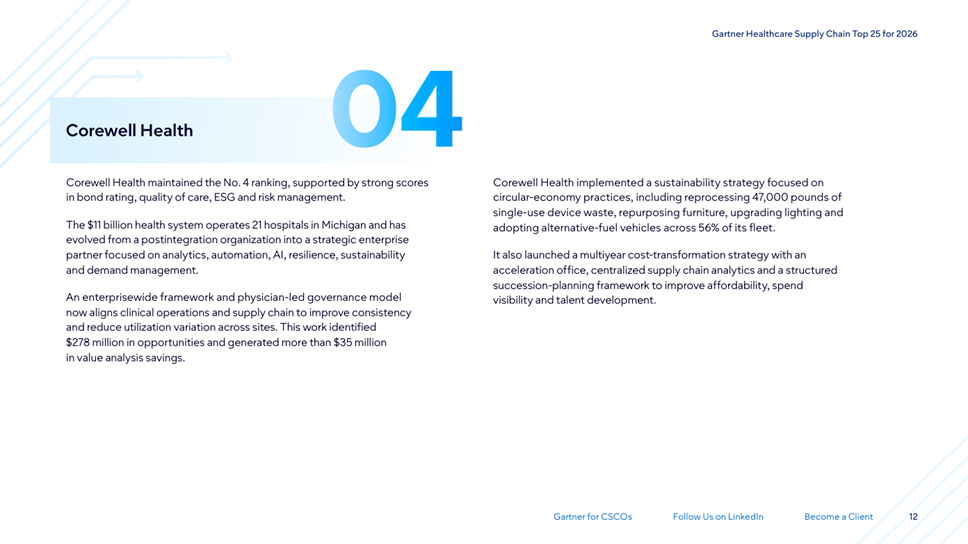
No. 4 — Corewell Health
Corewell Health maintained fourth place. Its physician-led governance and enterprise framework identified $278 million in opportunities and generated more than $35 million in value analysis savings. Its circular-economy work included reprocessing 47,000 pounds of single-use device waste, repurposing furniture, upgrading lighting and adopting alternative-fuel vehicles across 56% of its fleet.
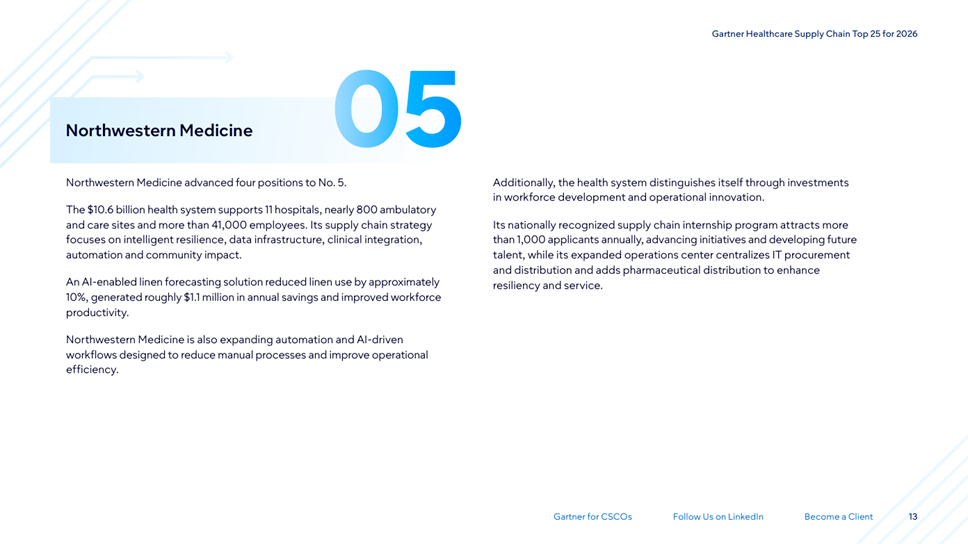
No. 5 — Northwestern Medicine
Northwestern Medicine advanced four positions to fifth. An AI-enabled linen forecasting solution reduced linen use by approximately 10%, generated roughly $1.1 million in annual savings and improved workforce productivity. The report also highlights automation, AI-driven workflows, workforce development and a centralized operations center.
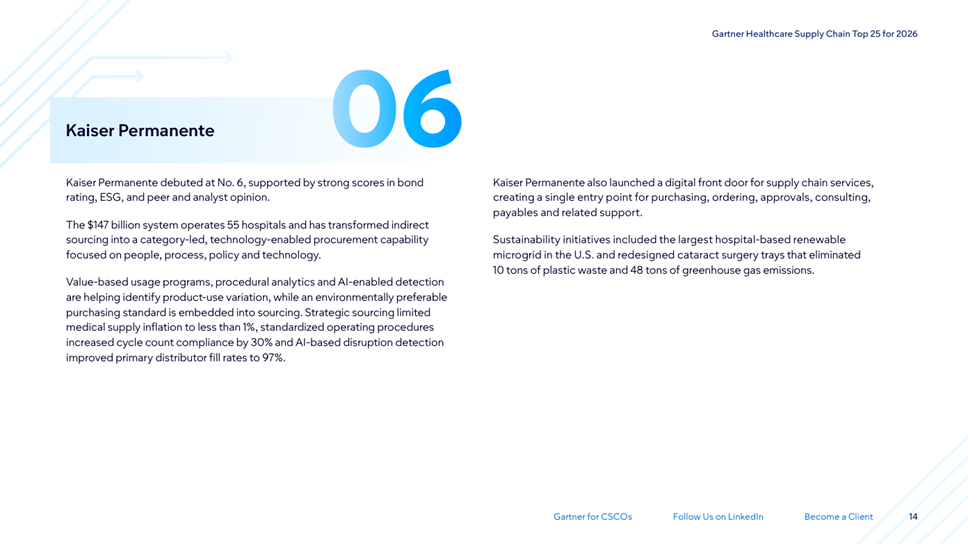
No. 6 — Kaiser Permanente
Kaiser Permanente debuted at No. 6. AI-enabled detection helped identify product-use variation, while strategic sourcing limited medical supply inflation to less than 1%. Standardized operating procedures increased cycle count compliance by 30%, and AI-based disruption detection improved primary distributor fill rates to 97%. Sustainability initiatives included redesigned cataract surgery trays that eliminated 10 tons of plastic waste and 48 tons of greenhouse gas emissions.
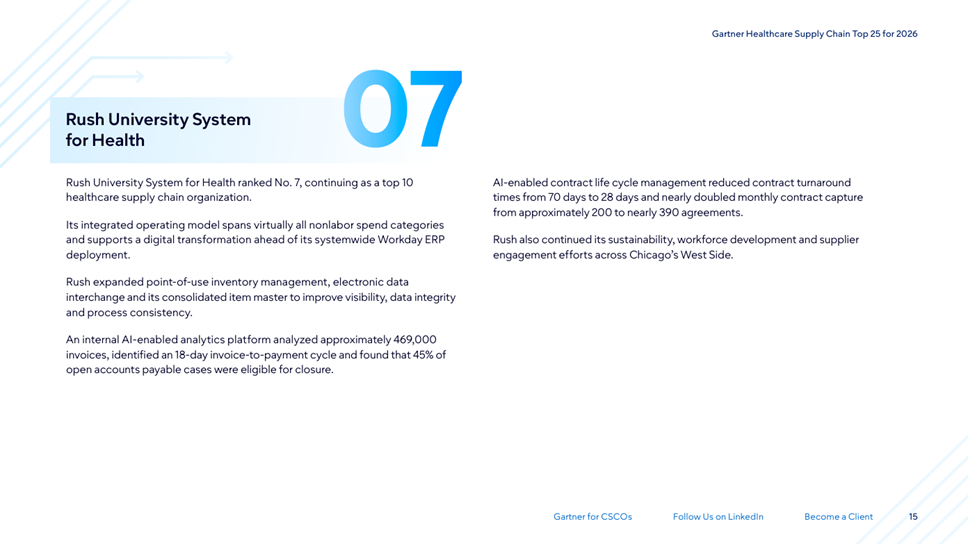
No. 7 — Rush University System for Health
Rush expanded point-of-use inventory management, electronic data interchange and its consolidated item master to improve visibility and data integrity. Its internal AI-enabled analytics platform analyzed approximately 469,000 invoices. AI-enabled contract life cycle management reduced contract turnaround times from 70 days to 28 days and nearly doubled monthly contract capture, from approximately 200 to nearly 390 agreements.
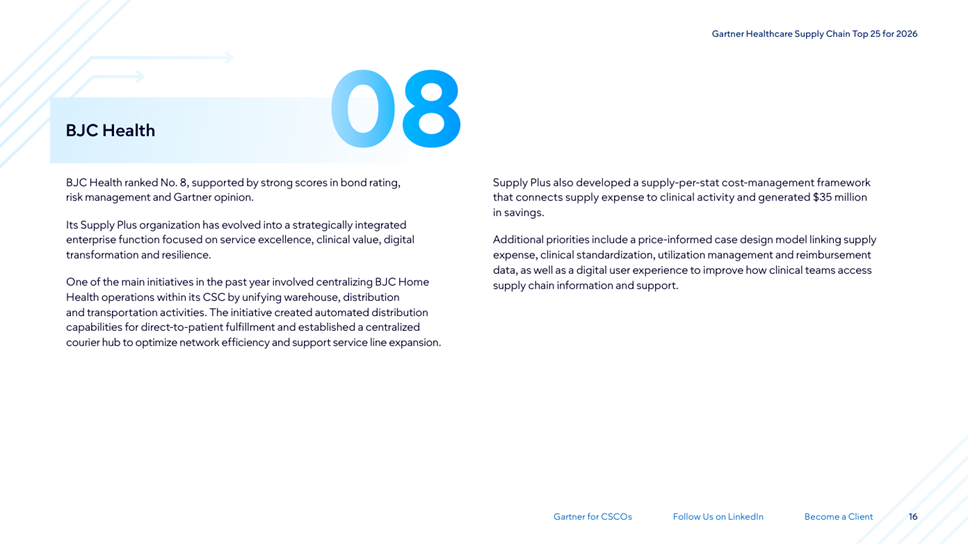
No. 8 — BJC Health
BJC Health’s Supply Plus organization focused on service excellence, clinical value, digital transformation and resilience. Centralizing home health operations within its consolidated service center unified warehouse, distribution and transportation activities. A supply-per-stat cost-management framework connecting supply expense to clinical activity generated $35 million in savings.
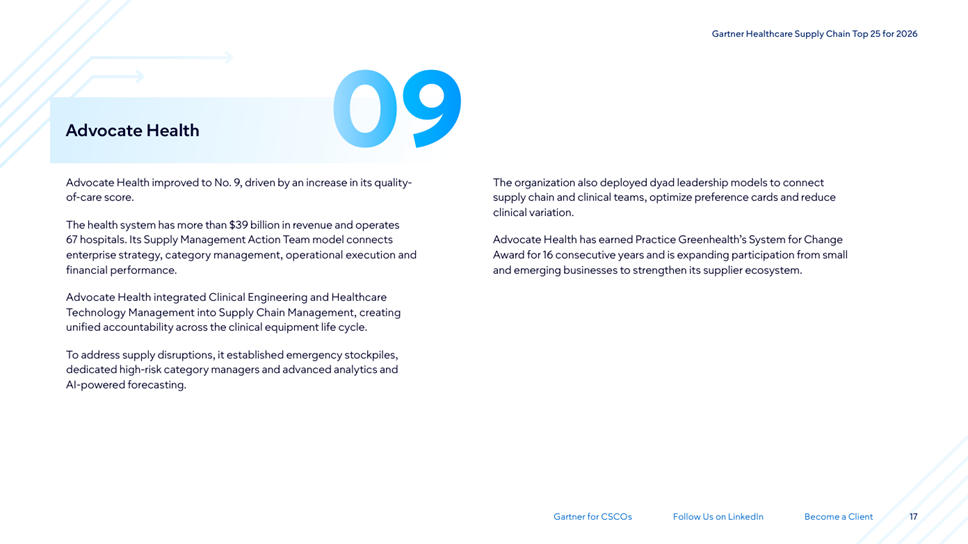
No. 9 — Advocate Health
Advocate Health improved to ninth place. It established emergency stockpiles, dedicated high-risk category managers, and advanced analytics and AI-powered forecasting to address supply disruptions. Its model also connects supply chain and clinical teams through dyad leadership, preference-card optimization and efforts to reduce clinical variation.
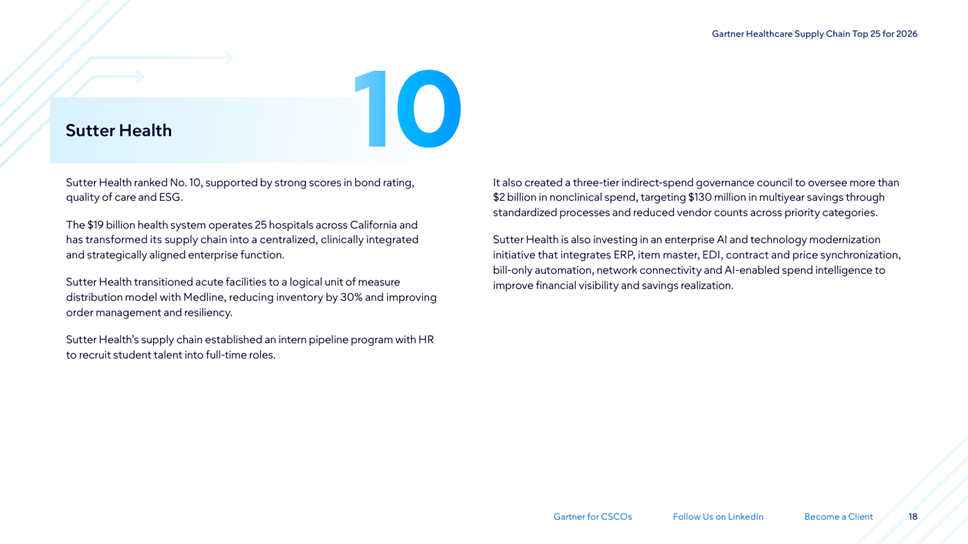
No. 10 — Sutter Health
Sutter Health ranked tenth. Transitioning acute facilities to a logical unit of measure distribution model reduced inventory by 30% and improved order management and resilience. The organization is also investing in enterprise AI and technology modernization connecting ERP, item master, EDI, contracts, price synchronization, bill-only automation, network connectivity and AI-enabled spend intelligence.
Lessons for Healthcare Supply Chain Leaders
- Make clinical collaboration part of governance. Involve physicians in sourcing, product decisions and supplier accountability early.
- Design resilience before a disruption occurs. Build alternative sources, inventory visibility, approved substitutions and flexible distribution options.
- Use AI to address specific operational bottlenecks. Contract intelligence, forecasting, procure-to-pay automation and disruption detection are concrete use cases described in the report.
- Create trusted, standardized data foundations. Modern ERP, item master and analytics platforms help connect clinical, financial and operational information.
- Measure outcomes beyond unit price. Patient care, continuity, utilization, sustainability, workforce productivity and financial stewardship all matter.
- Connect sustainability with operational redesign. Reprocessing, waste reduction, fleet changes and environmentally preferable purchasing can be integrated into supply chain strategy.
Conclusion: Build Supply Chains That Protect Care and Improve Performance
Gartner’s 2026 Healthcare Supply Chain Top 25 presents a clear picture of the capabilities shaping the sector’s leaders. Clinical partnership, resilience and digital advancement are not separate initiatives: they reinforce one another. Better data can help clinicians compare utilization, help supply chain teams anticipate shortages and help finance teams capture contract value. Resilient networks protect care, while sustainability and operational efficiency support responsible use of resources.
For healthcare organizations looking to strengthen their supply chains, the report’s central lesson is to move beyond transactional procurement. Build an integrated capability that connects clinical priorities, supplier networks, reliable data, technology and measurable patient and business outcomes.
Source note: This blog is based on the supplied Gartner document, “Healthcare Supply Chain Top 25 for 2026.” Rankings, statistics and examples are presented as reported in that document. The supplied PDF includes detailed profiles for ranks 1–10 and does not provide the full individual profiles for all 25 organizations.
Complete Original PDF Visuals
All 20 pages from the supplied Gartner PDF are reproduced below to preserve the original cover, themes, rankings, organization profiles, charts and resource pages.